
Free Preview
Polylactic Acid (PLA) Synthesis Virtual Laboratory Configuration
The Polylactic Acid (PLA) Synthesis Virtual Laboratory provides a multi-stage simulation environment for studying the catalytic synthesis, devolatilization, and characterization of bio-...

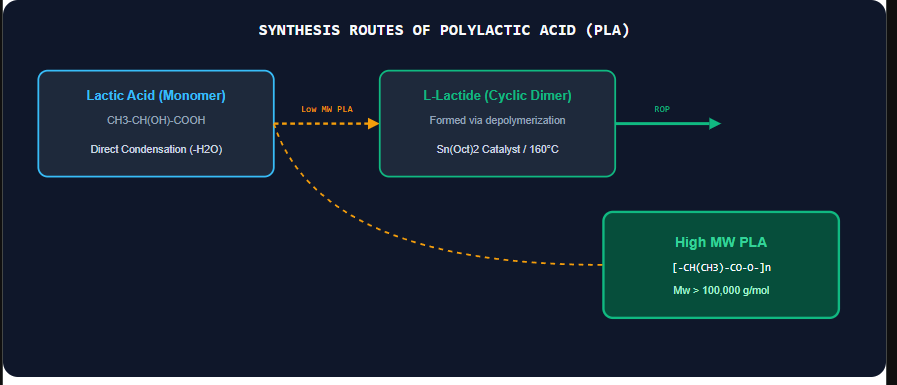
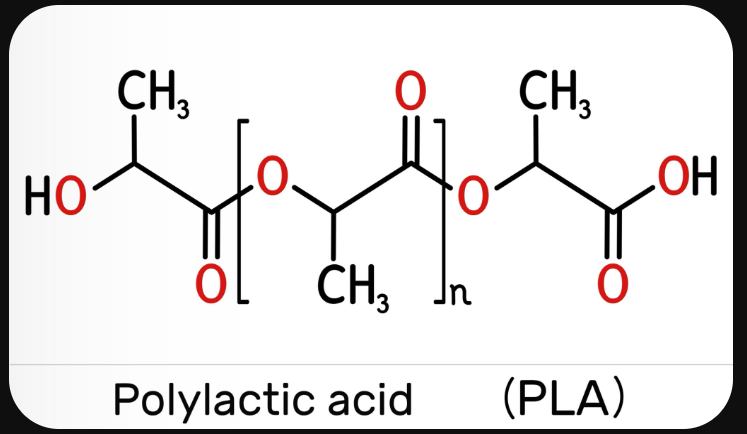
The Polylactic Acid (PLA) Synthesis Virtual Laboratory provides a multi-stage simulation environment for studying the catalytic synthesis, devolatilization, and characterization of bio-based polyesters. The software models two primary synthetic pathways: Ring-Opening Polymerization (ROP) of $L$-lactide using tin(II) octoate ($\text{Sn(Oct)}_2$) and Direct Polycondensation (DPC) of $L$-lactic acid using $p$-toluenesulfonic acid ($p$-TSA).
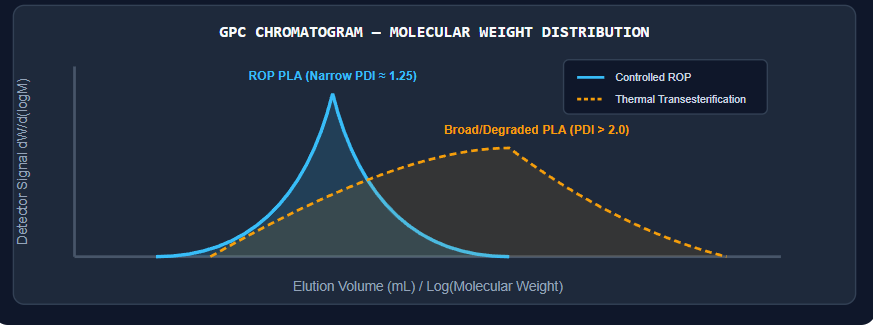
Mechanism Comparison: To analyze the differences between chain-growth Ring-Opening Polymerization (ROP) and step-growth Direct Polycondensation (DPC) regarding reaction rate, equilibrium constraints, and final molecular weight ($M_w$).Kinetic & Thermal Modeling: To observe the effects of temperature, catalyst concentration ($\text{wt}\%$), stirring speed ($\text{RPM}$), and environmental moisture on monomer conversion, polydispersity index ($\text{PDI}$), and thermal runaway risks.Monomer Purification: To reduce residual unreacted monomer below the $1.0\text{ wt}\%$ food-grade/medical safety threshold using vacuum devolatilization.Analytical Characterization: To evaluate synthesized PLA samples using simulated FTIR spectra, DSC thermograms (identifying $T_g$, $T_{cc}$, $T_m$, and $\chi_c$), TGA mass-loss curves, and GPC molecular weight distribution curves.
nteractive Fume Hood & Reactor Viewport: SVG-rendered reactor setup featuring a round-bottom flask, heating mantle, overhead stirrer, reflux condenser, nitrogen purge line, and vacuum manifold.Precision Analytical Balance: Digital scale interface for weighing $L$-lactide crystals, $L$-lactic acid solution, tin(II) octoate catalyst, $p$-TSA, and benzyl alcohol initiator inside an optional inert $\text{N}_2$ glovebox environment.Real-Time Kinetics Dashboard: Dynamic plotting engine tracking monomer conversion ($\%$), weight-average molecular weight ($M_w$), polydispersity index ($\text{PDI} = M_w/M_n$), stirrer torque ($\text{N}\cdot\text{m}$), and energy consumption ($\text{kWh}$).Devolatilization Unit: High-vacuum stripping module to extract volatile residual monomers.Analytical Instrument Suite: Integrated characterization modules for FTIR, DSC, TGA, and GPC with automated dataset export ($\text{.CSV}$) and printable PDF lab report generation.
Step 1: Safety Check & Pathway SelectionEquip required Personal Protective Equipment (PPE) by clicking the Lab Coat, Safety Goggles, and Nitrile Gloves.Select the synthetic route:Experiment A: Ring-Opening Polymerization (ROP): High molecular weight pathway utilizing $L$-lactide monomer, $\text{Sn(Oct)}_2$ catalyst, and benzyl alcohol initiator.Experiment B: Direct Polycondensation (DPC): Step-growth condensation route utilizing aqueous $L$-lactic acid and $p$-TSA catalyst under vacuum.Click Proceed to Weighing Station.Step 2: Reagent Weighing & Glovebox TransferToggle the $\text{N}_2$ Glovebox to ON (essential for ROP to exclude ambient moisture that causes chain termination).Select $L$-Lactide from the inventory, place the weighing boat on the balance, click Tare, and add reagent until reaching approximately $10.0\text{ g}$.Select $\text{Sn(Oct)}_2$ Catalyst and add approximately $0.005\text{ g}$ ($0.05\text{ wt}\%$).For ROP, select Benzyl Alcohol Initiator and add approximately $0.020\text{ g}$ to control target molecular weight.Click Transfer to Flask & Continue.Step 3: Reactor Apparatus AssemblyClick the equipment components in order to construct the reaction setup:Click R.B. Flask to set the vessel containing pre-weighed reagents.Click Oil-Jacketed Reactor / Heating Mantle to mount the vessel.Click Reflux Condenser to prevent volatile monomer loss.Click Nitrogen Line to establish an inert dry atmosphere.Verify all four connections show green indicators, then click Proceed to Control Panel.Step 4: Polymerization Execution & Parameter ControlSet the reaction parameters using the control sliders:Temperature ($T$): Set to $160^\circ\text{C}$ (optimal range: $140^\circ\text{C} - 180^\circ\text{C}$).Duration ($t$): Set to $120\text{ min}$.Stirrer Speed: Set to $300\text{ RPM}$.Cooling System: Enable the Cooling Jacket toggle to manage exotherm heat buildup and prevent thermal runaway.Click Start Polymerization and observe the live indicators:Monitor conversion ($\%$) and molecular weight ($M_w$) growth on the Kinetics Graph.Watch the visualizer: the white lactide crystals melt into a clear liquid that gradually increases in viscosity and turns light golden-amber as polymerization proceeds.If temperature spikes above $180^\circ\text{C}$ without nitrogen or cooling, thermal degradation (back-biting) occurs, darkening the melt.Upon reaction completion, click Proceed to Devolatilization.Step 5: Vacuum Devolatilization (Monomer Stripping)Review the initial residual monomer percentage ($100 - \text{Conversion}\%$).Adjust devolatilization controls: set Vacuum Level to $< 1.0\text{ mbar}$ and Rotor Speed to $150\text{ RPM}$.Set duration to $30\text{ min}$ and click Apply Vacuum.Observation: High vacuum strips unreacted lactide monomer from the molten polymer film, reducing residual levels below the $1.0\text{ wt}\%$ food/medical grade threshold.Click Proceed to Characterization.Step 6: Polymer Characterization & Data ExportClick Weigh & Crimp Al Pan under Sample Preparation for thermal analysis.Click Dissolve & Filter ($\text{CHCl}_3$) for solution analysis.Inspect generated analytical data across all four tabs:FTIR: Confirm ester carbonyl ($\text{C=O}$) stretching at $1748\text{ cm}^{-1}$ and $\text{C-O-C}$ stretching at $1090-1180\text{ cm}^{-1}$.DSC: Identify Glass Transition ($T_g \approx 55-60^\circ\text{C}$), Cold Crystallization ($T_{cc} \approx 100-115^\circ\text{C}$), Melting Peak ($T_m \approx 150-160^\circ\text{C}$), and calculate percent crystallinity ($\chi_c$).TGA: Verify thermal stability onset ($T_d \approx 290^\circ\text{C}$).GPC: Evaluate $M_n$, $M_w$, and polydispersity index ($\text{PDI}$).Click Export CSV to save time-series kinetics datasets, or click Export PDF to print the complete laboratory record.
Initializing secure sandbox environment & decrypting simulation...