
Free Preview
Determination of the Liquid Limit of a Soil Sample Using Casagrande’s Method
The liquid limit (LL) of a soil is the minimum moisture content at which the soil changes from a plastic state to a liquid state. It is a crucial property in soil mechanics, influencing...
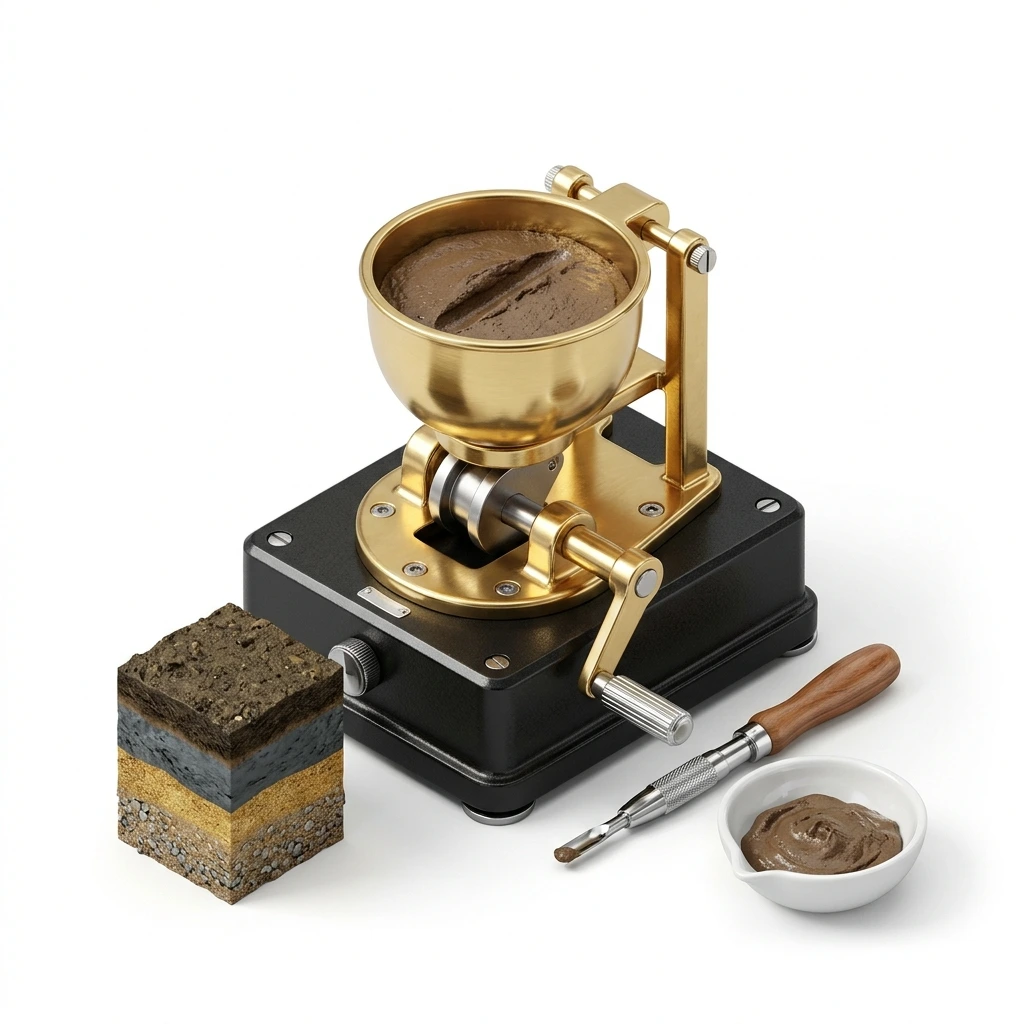
The liquid limit (LL) of a soil is the minimum moisture content at which the soil changes from a plastic state to a liquid state. It is a crucial property in soil mechanics, influencing compaction, consolidation, and shear strength.
The Casagrande liquid limit apparatus is commonly used for this test. A soil paste is placed in a standard brass cup and a groove is cut. The number of blows required to close the groove over a distance of 12 mm is recorded. The moisture content corresponding to 25 blows is taken as the liquid limit.
Moisture content at 25 blows (%)
To determine the liquid limit of a given soil sample.
To understand the consistency limits of soil.
To develop skills in soil preparation, handling, and testing using the Casagrande apparatus.
To evaluate the soil’s engineering properties for foundation and earthwork design.
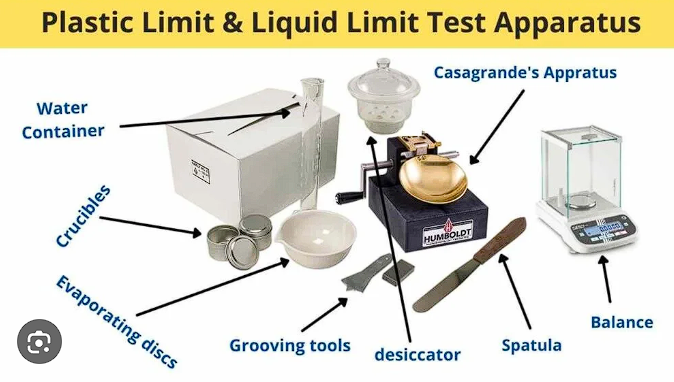
Casagrande liquid limit apparatus
Grooving tool
Oven
Balance / Weighing scale
Spatula, mixing bowl, and glass plate
Distilled water
Soil sample
Preparation of soil sample
Take a representative soil sample and air-dry it if needed.
Sieve through a 425 µm sieve to remove coarse particles.
Mixing soil paste
Mix the soil with water gradually to form a uniform paste.
Filling the cup
Place the soil paste into the Casagrande cup and level the surface.
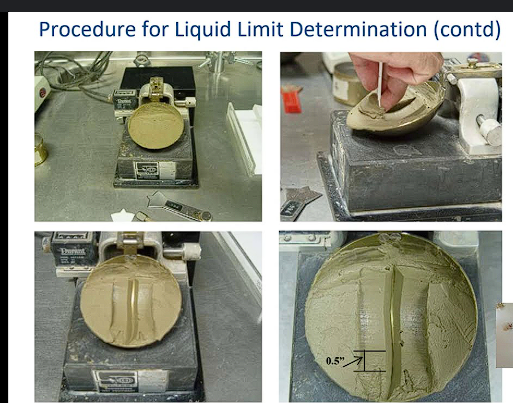
Cut a standard groove in the center using the grooving tool.
Performing the test
Turn the crank at a rate of 2 revolutions per second, allowing the cup to drop repeatedly.
Count the number of blows until the two halves of the groove just close over a 12 mm length.
Record the number of blows and corresponding moisture content.
Repeat for multiple moisture contents
Prepare soil pastes with varying moisture contents.
Perform tests for at least 3 different pastes.
Determine Liquid Limit
Plot a flow curve of moisture content vs. log(number of blows).
Interpolate the moisture content corresponding to 25 blows; this is the liquid limit.
Initializing secure sandbox environment & decrypting simulation...