
Access Granted
Free Preview
Civil Engineering
•
Practical #75
Interactive Simulation Available
Standard Proctor Compaction Test Virtual Lab
The Standard Proctor Compaction Test is a fundamental geotechnical procedure used to determine the relationship between moisture content and dry density of soil for a specific compactiv...
AI Topic: Geotechnical & Soil Mechanics
Civil & Geotechnical Engineering
Experiment Progress Pathway
0%
The Standard Proctor Compaction Test is a fundamental geotechnical procedure used to determine the relationship between moisture content and dry density of soil for a specific compactive effort. This virtual lab offers a high-fidelity simulation of the laboratory apparatus, including a standard mold with a volume of
$$944 ext{ cm}^3$$
and a manual rammer weighing $$2.5 ext{ kg}$$
. Students can manipulate different soil types and moisture levels to observe the effects of compaction in real-time, resulting in a dynamic compaction curve that helps identify the soil's peak stability points.- To understand the effect of moisture content on the degree of soil compaction.
- To experimentally determine the Maximum Dry Density (MDD) and Optimum Moisture Content (OMC).
- To visualize the physical compression of soil layers under repeated mechanical impact (blows).
- To apply the mathematical relationships for density:
$$\rho_{bulk} = \frac{Mass_{wet}}{Volume_{mold}}$$
$$\rho_{dry} = \frac{\rho_{bulk}}{1 + w}$$
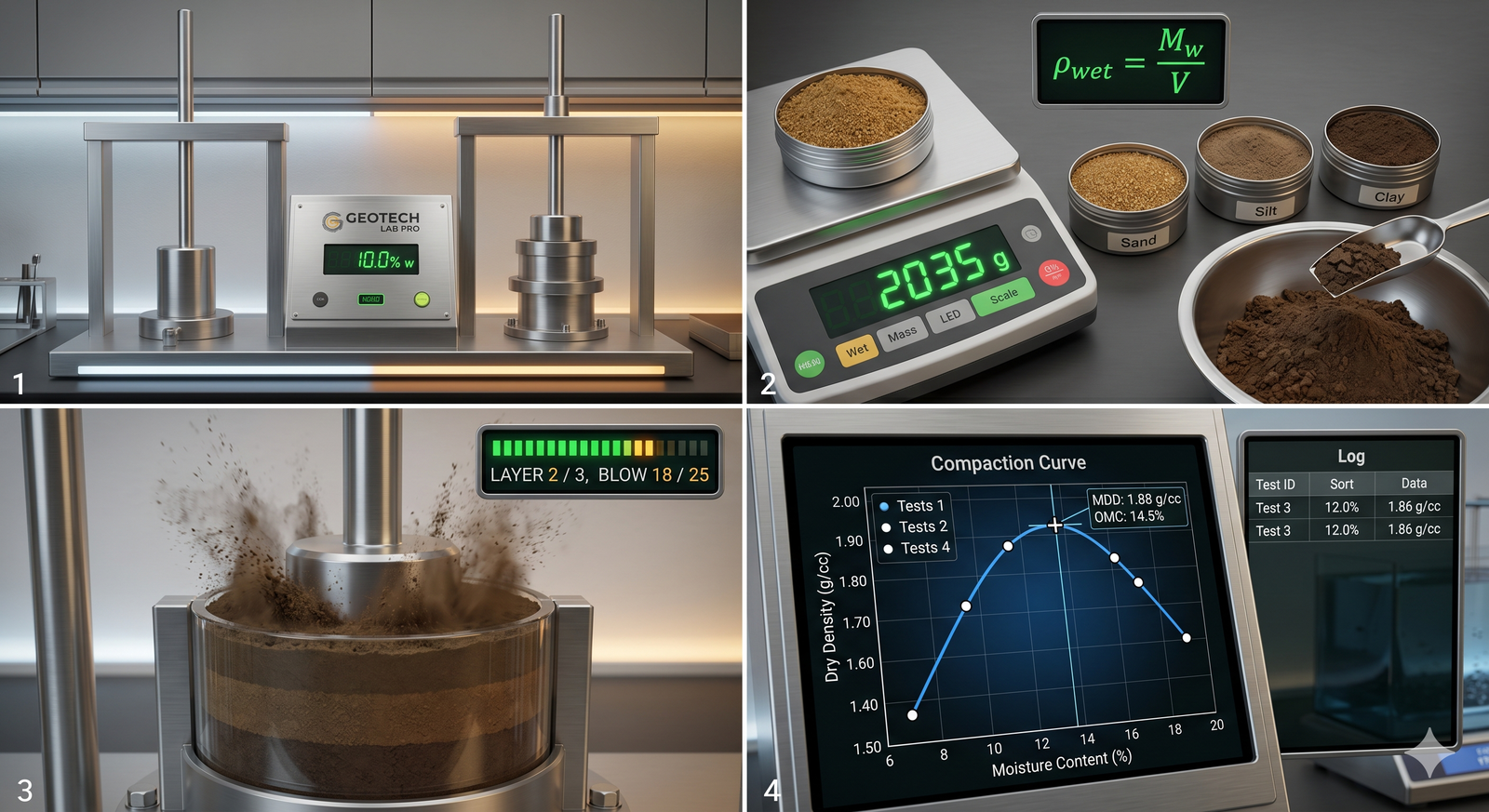
- Soil Profiles: Samples of Sand, Silt, and Clay with unique compaction characteristics.
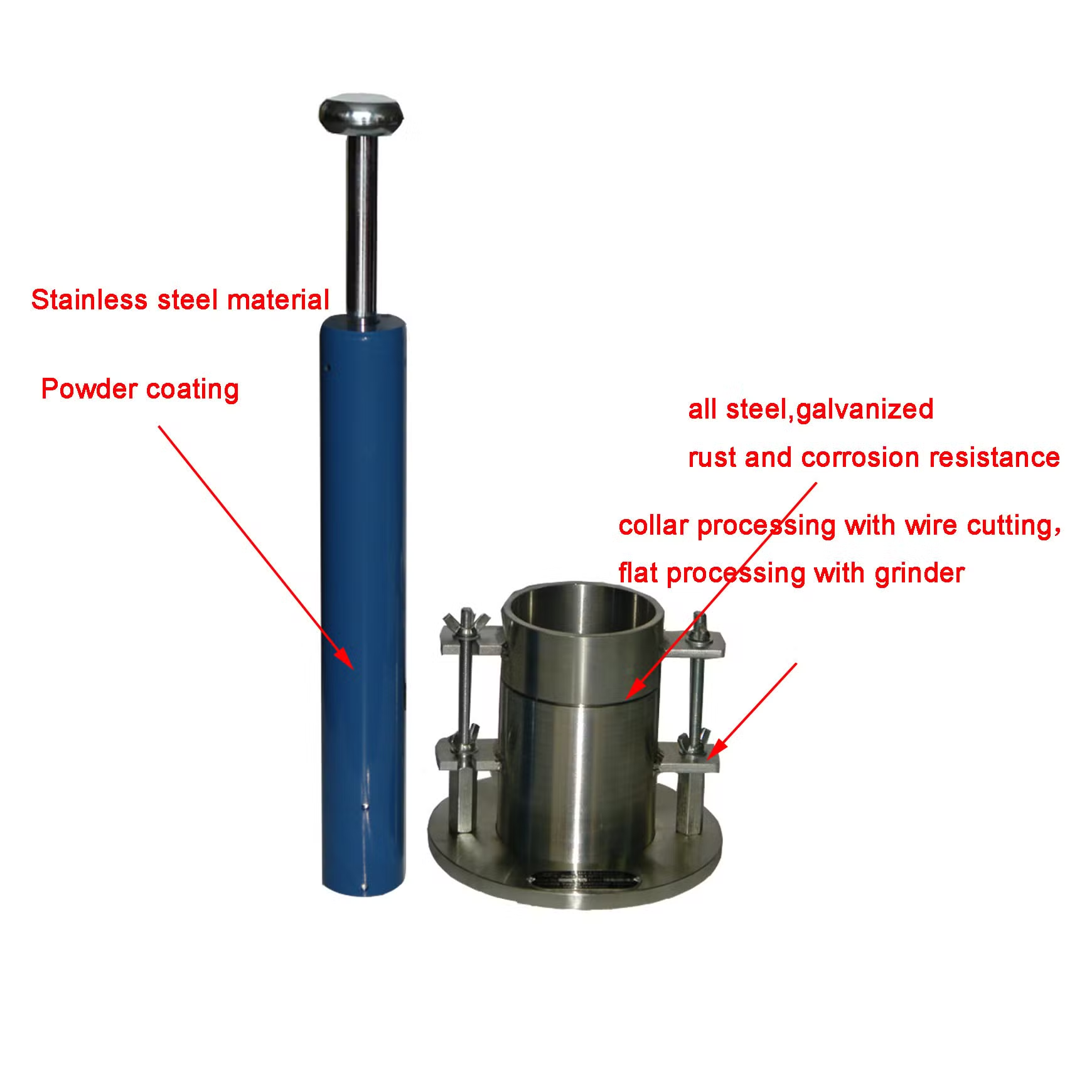
- Interactive Compaction Mold: Standardized volume of $$1/30\text{ cubic foot}$$with a removable collar.
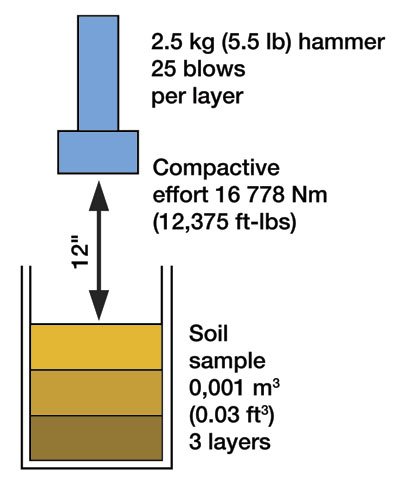
- Mechanical Rammer: Simulated weight of $$2.5\text{ kg}$$with a$$305\text{ mm}$$free-fall drop.
- Precision Digital Scale: For real-time weighing of tare ($$W_1$$) and gross ($$W_2$$) masses.
- Compaction Curve Plotter: Integrated Chart.js engine that generates a spline-fit curve from multiple data points.
- Soil Selection: Choose a soil type (e.g., Clay). Note the recommended dry mass provided by the simulator.
- Moisture Increment: Set the initial moisture content to $$8\%$$. The system will calculate the exact mass of water required.
- Compaction Process: Click Start. Observe the simulation as it:
- Fills the mold in three distinct layers.
- Applies $$25$$blows per layer using the rammer.
Student Authentication Required
Please login to your account to generate the quiz, record marks, and earn completion credit.
Initializing secure sandbox environment & decrypting simulation...