Access Granted
Free Preview
Civil Engineering • Practical #7 Interactive Simulation Available

Determination of the Dry Weight and Moisture Content of a Soil Sample

The dry soil determination experiment is a fundamental test in civil engineering used to determine the natural moisture (water) content of a soil mass. Soil contains varying amounts of ...
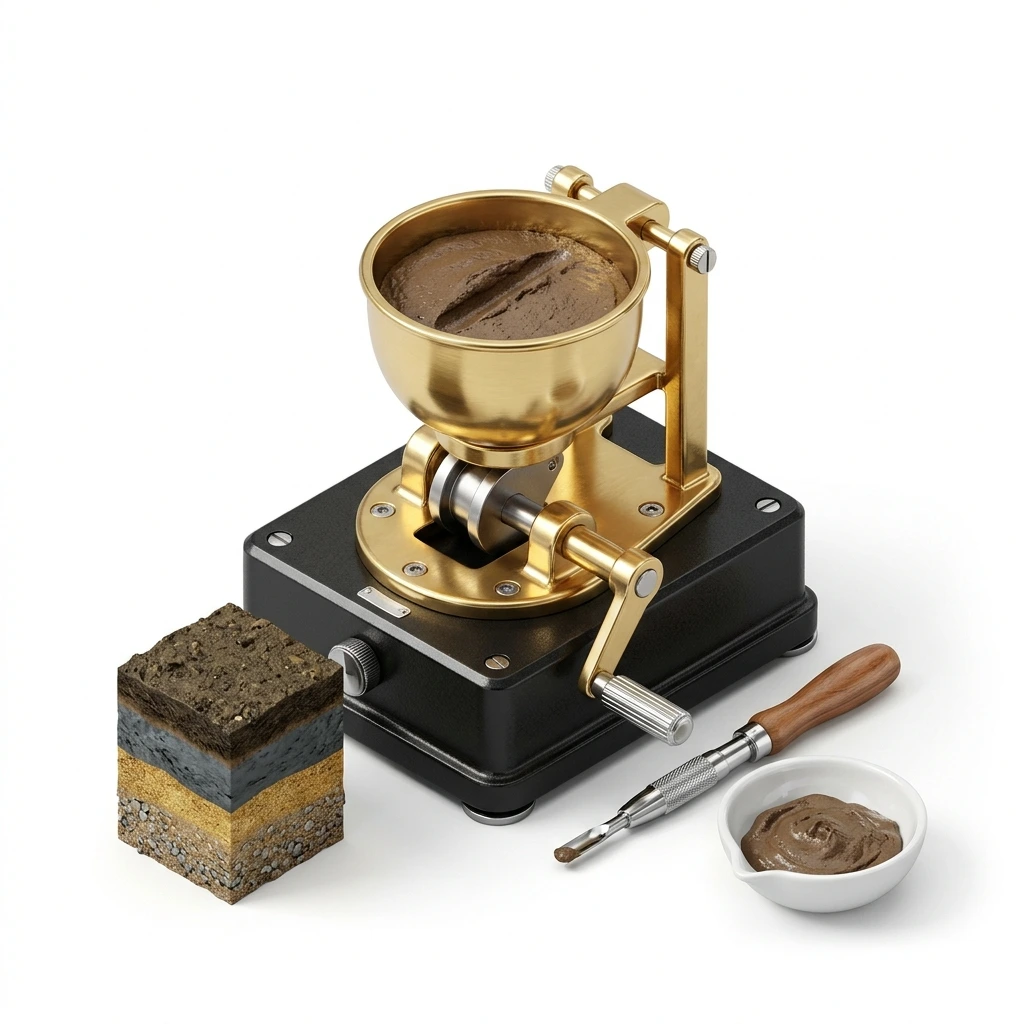
Civil Engineering Dry Soil Determination experiment: ID: 7
AI Topic: Geotechnical & Soil Mechanics
Determination of the Dry Weight and Moisture Content of a Soil Sample 3D Topic Apparatus
Civil & Geotechnical Engineering
Public Preview Mode Sign in to track progress pathway, generate AI quizzes, record completion, and access protected simulators.
ADVERTISEMENT
Experiment Progress Pathway
0%

The dry soil determination experiment is a fundamental test in civil engineering used to determine the natural moisture (water) content of a soil mass. Soil contains varying amounts of water within its voids, which significantly dictates its physical behavior, compaction characteristics, and shear strength. Accurate determination of this moisture is essential for calculating weight-volume relationships, predicting soil behavior under load, and safely designing foundations and earth-retaining structures.

To determine the dry weight of a given soil sample.

To calculate the exact moisture content of the soil.

To develop standard laboratory skills in soil handling, precision weighing, and thermal drying.

To understand the critical effect of moisture on soil properties for construction applications.

Moist Soil Sample: A representative specimen from the field.Moisture Container: Non-corrodible aluminum or glass container with a well-fitting lid.Analytical Balance: High-precision weighing scale (accurate to $0.01\text{ g}$).Hot Air Oven: Thermostatically controlled, capable of maintaining $105^\circ\text{C}$ to $110^\circ\text{C}$.Desiccator: Containing active silica gel to prevent moisture absorption during cooling.Spatula and Scoop: For safe material handling.
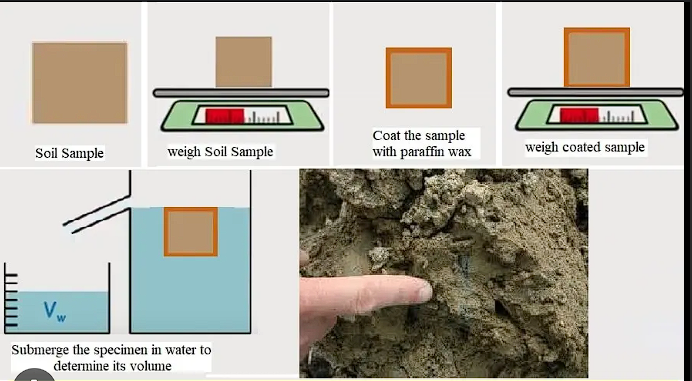
Preparation of Container: Clean and dry the moisture container thoroughly. Weigh the empty container (including its lid) and record its weight as $W_1$.Weighing Wet Soil: Place a representative sample of the moist soil into the container. Weigh the container with the wet soil and record this as $W_2$.Drying the Soil: Place the container with the soil into the hot air oven (keep the lid removed but alongside it). Maintain the temperature at $105^\circ\text{C}$ to $110^\circ\text{C}$ for 24 hours, or until a constant weight is achieved.Cooling: Remove the container from the oven, place the lid securely back on, and allow it to cool to room temperature inside a desiccator.Weighing Dry Soil: Once cooled, weigh the container containing the oven-dried soil and record this as $W_3$.Observation and Recording: Repeat the process for multiple samples (usually 3) to ensure accuracy and take the average.Calculations / Formula Card DataTo find the moisture content ($w$), you must divide the mass of the water lost by the mass of the strictly dry soil solids:
$$w = \frac{W_2 - W_3}{W_3 - W_1} \times 100$$
Where:$w$ = Moisture content of the soil (%)$W_1$ = Weight of empty container ($g$)$W_2$ = Weight of container + wet soil ($g$)$W_3$ = Weight of container + oven-dry soil ($g$)Note: $(W_2 - W_3)$ yields the mass of the evaporated water, and $(W_3 - W_1)$ yields the mass of the dry soil.

AI Knowledge Evaluation

10 AI-generated multiple-choice questions tailored to this practical. Score 7/10 (70%) or higher to verify experiment completion.

Student Authentication Required
Please login to your account to generate the quiz, record marks, and earn completion credit.
Interactive Simulation Sandbox

Initializing secure sandbox environment & decrypting simulation...

ADVERTISEMENT
× ❮ ❯

Practical Report Issue

Reporting for: Determination of the Dry Weight and Moisture Content of a Soil Sample

Developer Inspection Restricted

Developer Tools and source inspection are restricted on this platform to protect intellectual property and proprietary virtual laboratory simulations.

Welcome to Community Chat!

📢 Community Chat is Now Live

Connect with fellow learners in real-time! You can ask questions, share experiences, collaborate on experiments, and learn together.

Real-time messaging
Group discussions
File sharing
Online/offline presence

⚠️ Important Guidelines

  • Be respectful and professional
  • No spam, harassment, or inappropriate content
  • Keep discussions educational and relevant
  • Violations may result in warnings or bans

Read Full Community Guidelines →

Chat messages are monitored by the Virtual Lab team to ensure a safe environment. By continuing, you agree to our community guidelines and acceptable use policy.