
Free Preview
Virtual Laboratory on Cleaning Agents
This virtual laboratory provides a high-fidelity environment for studying the synthesis and properties of cleaning agents. Students can toggle between Soap (organic salts of fatty acids...

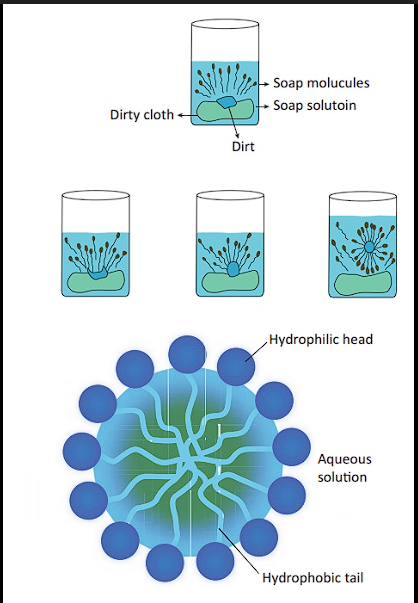
This virtual laboratory provides a high-fidelity environment for studying the synthesis and properties of cleaning agents. Students can toggle between Soap (organic salts of fatty acids) and Detergent (synthetic surfactants) to observe their behavior across five distinct tests. The simulator includes a Microscopic View for visualizing molecular interactions that are otherwise invisible to the naked eye, such as micelle attachment to dirt and the formation of insoluble scum.
- To understand the chemical synthesis of soap via the saponification process.
- To visualize and explain the cleaning action of surfactants through micelle formation.
- To compare the performance of soaps and detergents in hard water (containing $$Ca^{2+}$$or$$Mg^{2+}$$ions).
- To investigate the stability of cleaning agents in acidic environments ($$HCl$$).
- To evaluate the alkalinity (pH) levels of both agents using litmus indicators.
- Virtual Reagents: Vegetable oil/fat, Sodium Hydroxide $$NaOH$$, Hydrochloric Acid$$HCl$$, and Hard Water (Calcium Chloride solution$$CaCl_2$$).
- Interactive Glassware: Beakers, pipettes, and cloth patches with standardized 'dirt' blobs.
- Digital Tools: Real-time particle engine, molecular visualizer, and an automated observation log.
- Preparation: Select an agent (Soap or Detergent). Click 'Synthesize' to witness the chemical formation in the beaker.
- Cleaning Action: Observe the 'Microscopic View.' Notice the hydrophobic tails (water-repelling) embedding into the dirt while the hydrophilic heads (water-attracting) remain in the water.
- The Hard Water Test: Add $$Ca^{2+}$$ions. Observe how soap molecules bind with ions to form a white, sticky precipitate called 'Scum.' Note that detergent remains soluble and continues to function.
- Reaction with Acid: Add $$HCl$$to a soap solution. Watch the 'Microscopic View' as the$$H^+$$ions neutralize the soap heads, causing the fatty acids to precipitate out.
- Final Report: Once all tests are completed for both agents, the Conclusion Box will generate a comparative summary. Use the 'Generate Report' button to create a printable laboratory record.
Initializing secure sandbox environment & decrypting simulation...