
Free Preview
Investigating Friction on an Inclined Plane
Friction is the resistive force that opposes the relative motion of two surfaces in contact. When an object is placed on an inclined plane, the force of gravity must be resolved into tw...

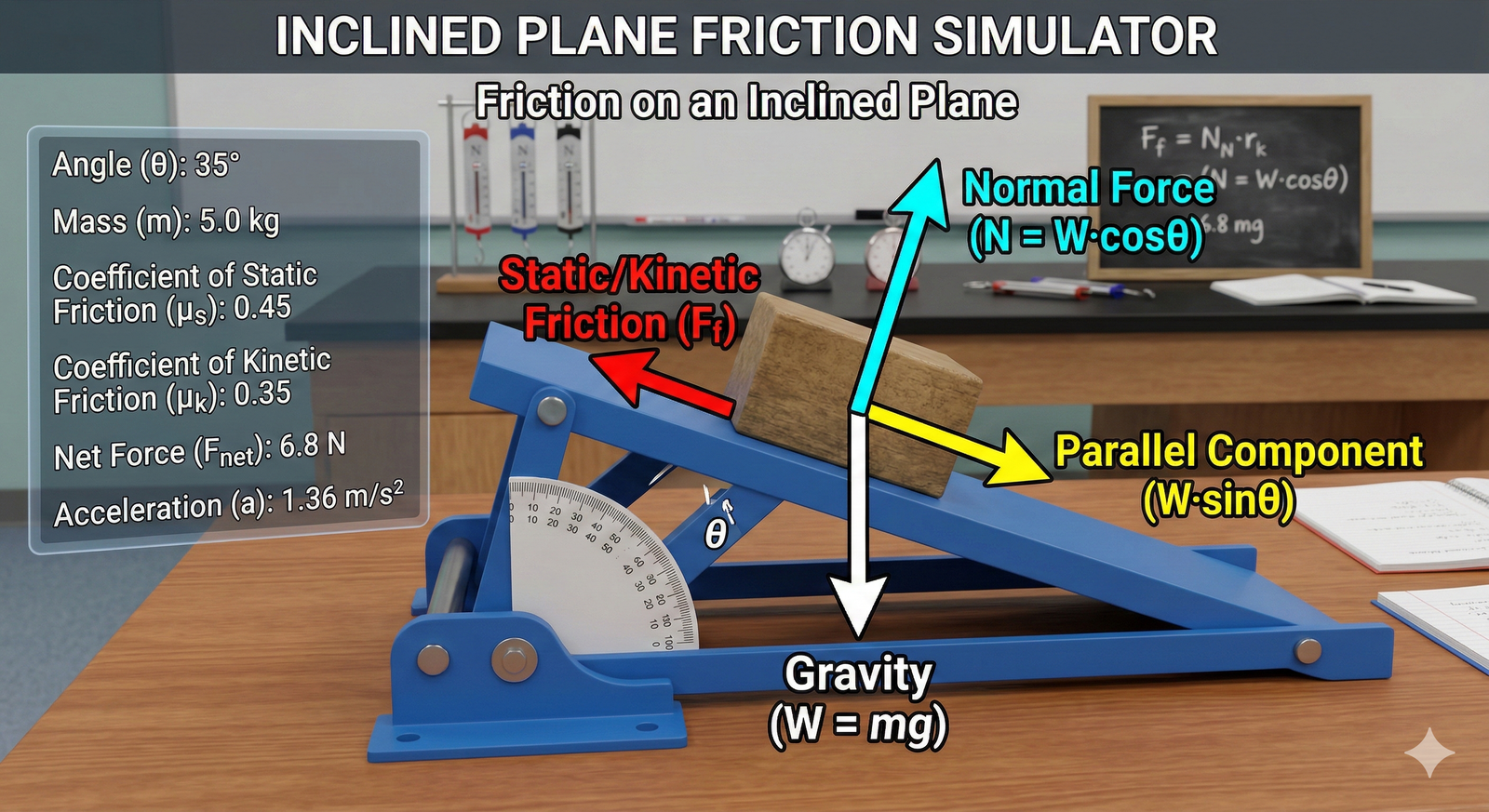
Friction is the resistive force that opposes the relative motion of two surfaces in contact. When an object is placed on an inclined plane, the force of gravity must be resolved into two components: one acting parallel to the surface (causing it to slide) and one acting perpendicular to the surface (the normal force). This 3D virtual laboratory allows students to manipulate the angle of inclination, object mass, and surface materials to observe how these variables affect the static and kinetic friction limits.
- To resolve the weight vector of an object into parallel and perpendicular components relative to an inclined plane.
- To understand the difference between the coefficient of static friction (μs) and kinetic friction (μk).
- To determine the "angle of repose"—the critical angle at which an object just begins to slide.
- To calculate net force and acceleration using Newton's Second Law:$$F_{net} = m ullet a = Wullet ext{sin}( heta) - f_k$$
- Virtual 3D Environment: Interactive classroom with an adjustable ramp and sliding block.
- Live Vector Display: Real-time 3D arrows showing Gravity (W), Normal Force (N), Parallel Pull, Applied Push, and Friction (f).
- Surface Presets: Material properties for Plain Paper, Oil, and Water to alter friction coefficients.
- Telemetry Dashboard: Live calculations of all forces, net acceleration, and velocity.
- Data Logger: Built-in observation table with CSV export capabilities.
- Initial Setup: Set the ramp angle to 0° and the mass to 5.0 kg. Observe that the Normal force (N) is equal to the Weight (W).
- Angle of Repose: Gradually increase the Angle (θ) slider. Watch the Parallel Pull (yellow vector) increase and the Normal force (cyan vector) decrease. Stop the slider exactly when the block begins to slide. Record this angle. The coefficient of static friction can be calculated as:$$c_s = ext{tan}( heta_{repose})$$
- Kinetic Motion: Once the block is sliding, observe the Live Telemetry. Note that the Friction force drops from the maximum static limit (F_{s(max)}) to the kinetic value (F_k).
- Applying External Force: Click "Reset". Increase the angle to 45° so the block slides down. Now, use the Applied Push (F_{app}) slider to apply a positive force (pushing UP the ramp). Find the exact force required to hold the block at rest.
- Data Collection: Use the "Record" button to capture data points at various angles and mass settings. Export the data to CSV for further graphical analysis.
Initializing secure sandbox environment & decrypting simulation...