
Free Preview
Microscopic Analysis of States of Matter and Phase Transitions
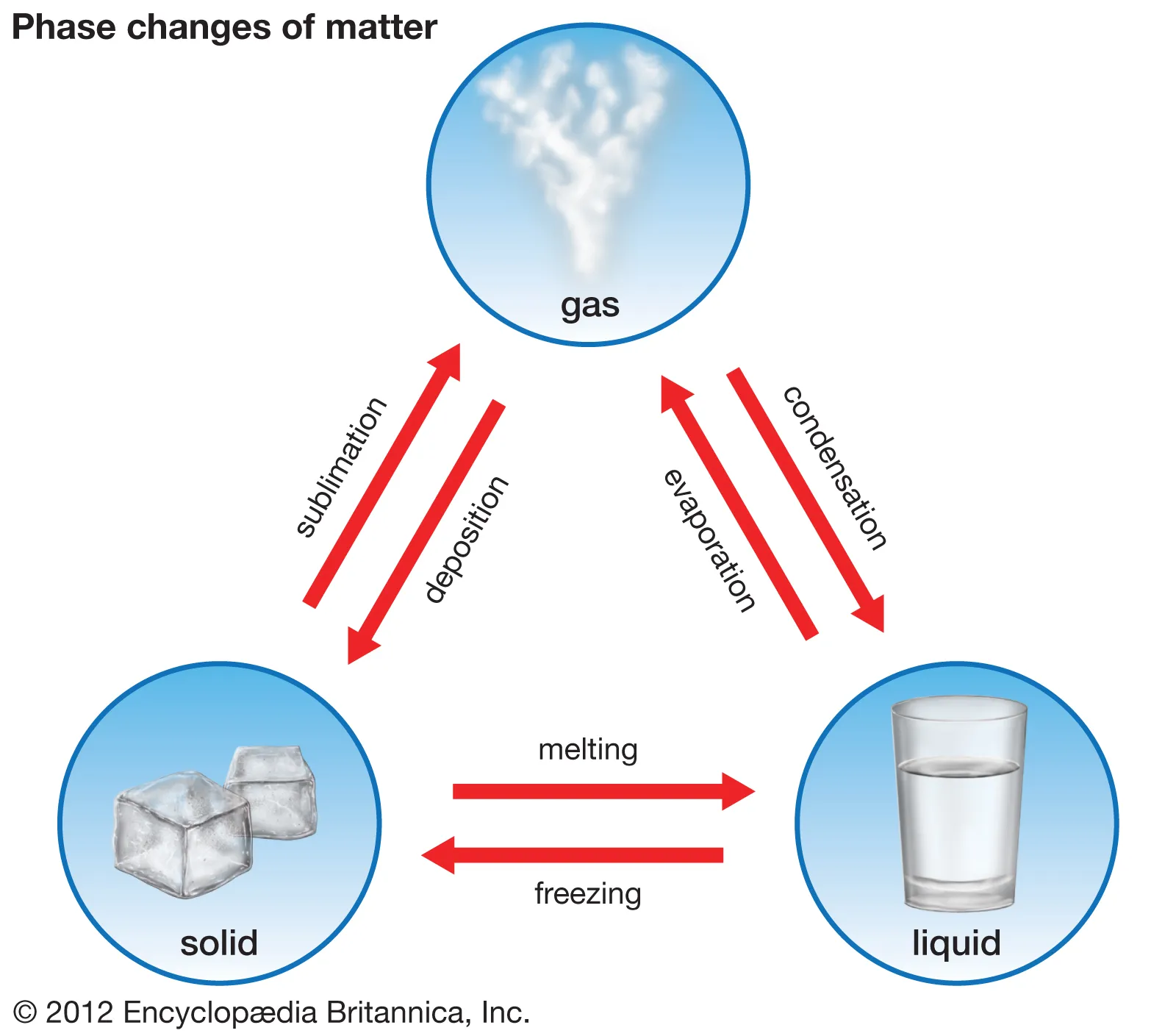
Matter is anything that has mass and occupies space. It primarily exists in three physical states: Solid, Liquid, and Gas. This virtual experiment utilizes a particle-based kinetic engi...

Matter is anything that has mass and occupies space. It primarily exists in three physical states: Solid, Liquid, and Gas. This virtual experiment utilizes a particle-based kinetic engine to allow students to visualize the hidden world of atoms. By manipulating thermal energy using a virtual burner or refrigerator, students can observe how kinetic energy overcomes intermolecular forces, leading to phase changes such as melting and boiling.
- To visualize the arrangement and motion of particles in the three fundamental states of matter.
- To investigate the relationship between Temperature and Kinetic Energy at the molecular level.
- To observe and identify the characteristics of phase transitions (Melting, Freezing, and Vaporization).
- To understand how pressure changes in a closed container as a result of molecular collisions.
- Virtual Pressure Chamber: A sealed glass beaker designed to contain molecules.
- Thermal Control Pump: An integrated gas burner for heating and a cooling chamber for refrigeration.
- Digital Telemetry: Real-time sensors for measuring Temperature (Kelvin) and Pressure (Atmospheres).
- Particle Generator: A dynamic simulation capable of generating 40 to 220 molecules with optional motion trails.
- Part A: Observing the Solid State (Ice)
- Set the Temperature to $$50 ext{ K}$$or click the 'Ice' preset.
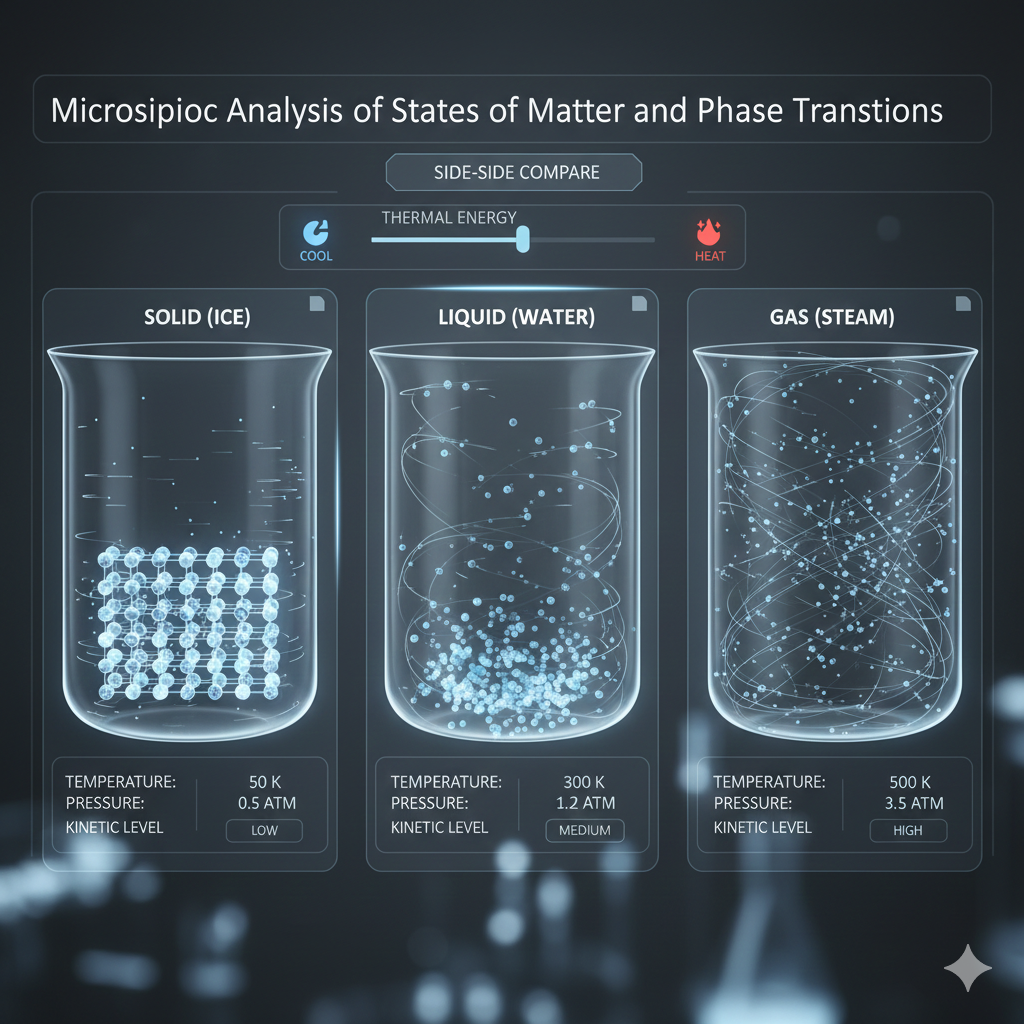
- Observe the particles. Note how they are locked in a rigid, repeating lattice structure and only vibrate about fixed positions.
- Check the Kinetic Level indicator; it should display 'Low.'
- Set the Temperature to
- Part B: Melting and the Liquid State (Water)
- Gradually increase the temperature using the slider or click the 'Water' preset.
- Observe the transition at approximately $$150 ext{ K}$$. Watch as the rigid structure collapses.
- Note that the particles now remain at the bottom of the beaker but flow freely past one another, taking the shape of the container.
- Part C: Vaporization and the Gaseous State (Steam)
- Increase the heat significantly (above $$400 ext{ K}$$) or click the 'Steam' preset.
- Watch as the molecules gain enough kinetic energy to break free from liquid attractions.
- Observe the particles moving rapidly in random directions, filling the entire volume of the beaker.
- Increase the heat significantly (above
- Part D: Comparative Analysis
- Switch to the 'Side-by-Side Compare' tab.
- Analyze the simultaneous behavior of the three states.
- Observe the 'Pressure' reading. Note how it increases as you move from liquid to gas, resulting from more frequent molecular collisions with the beaker walls.
Initializing secure sandbox environment & decrypting simulation...