
Free Preview
Experimental Study on the Conditions Required for the Rusting of Iron
This interactive chemistry simulation demonstrates the environmental conditions necessary for the corrosion (rusting) of iron. By isolating variables across three distinct test tube set...
This interactive chemistry simulation demonstrates the environmental conditions necessary for the corrosion (rusting) of iron. By isolating variables across three distinct test tube setups, students can visually deduce that both oxygen (air) and moisture (water) are essential for the oxidation process to occur.
To investigate the essential conditions required for the rusting of iron. To understand the chemical process of oxidation resulting in hydrated iron (III) oxide:
- Test Tubes (x3): For isolating different environmental conditions.
- Clean Iron Nails: The primary test subjects.
- Distilled Water: Provides both moisture and dissolved air.
- Boiled Distilled Water & Oil: Provides moisture while excluding oxygen.
- Anhydrous Calcium Chloride ($CaCl_2$): Absorbs moisture to create a completely dry air environment.
- Rubber Corks: To seal the environments.
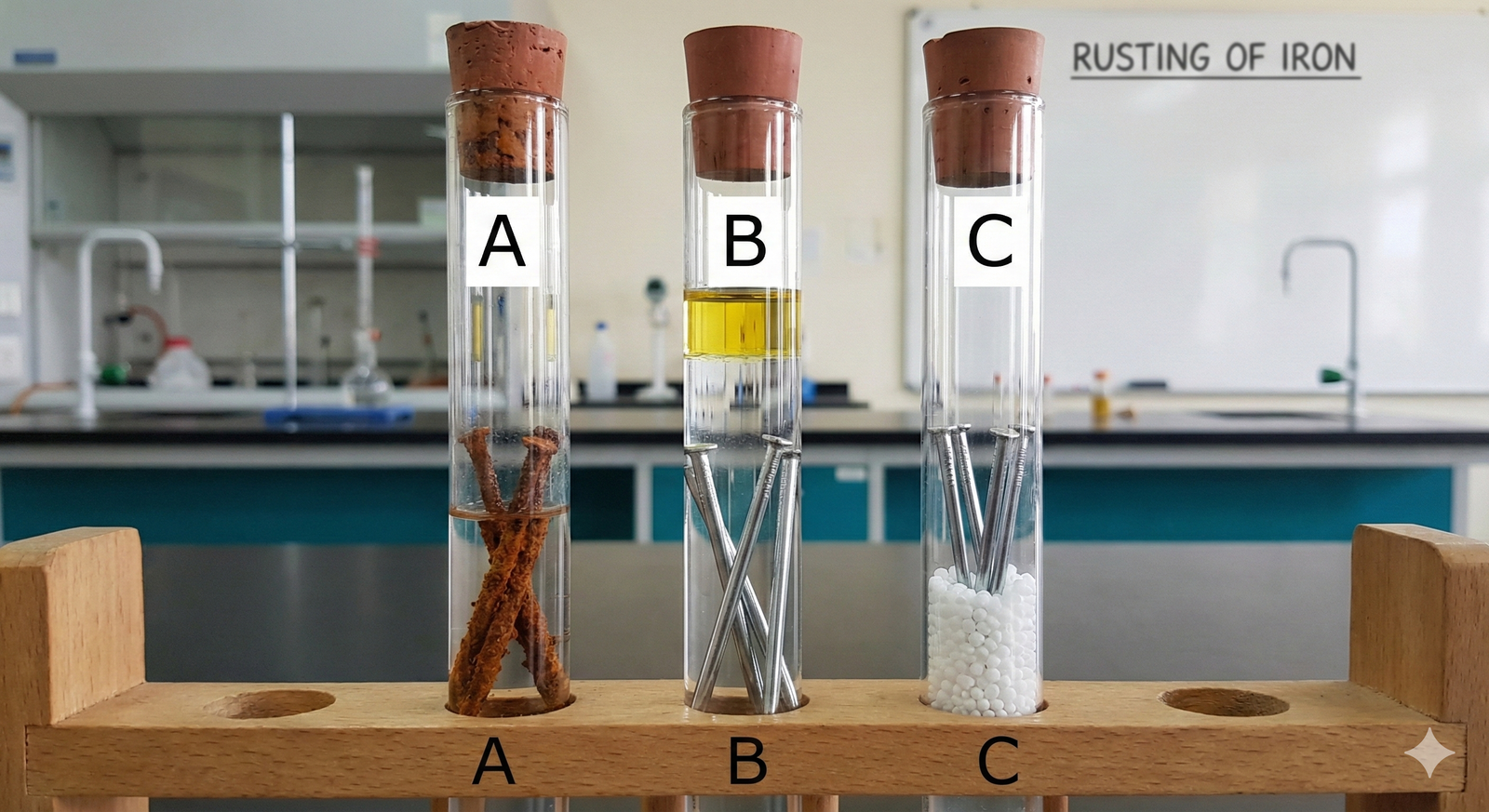
- Reagent Setup: Prepare three test tubes. Add distilled water to Tube A, boiled water sealed with an oil layer to Tube B, and anhydrous $CaCl_2$ to Tube C.
- Sample Insertion: Place clean, rust-free iron nails into each of the three test tubes.
- Sealing: Cork the tubes to create closed systems, ensuring no outside air or moisture can alter the controlled environments.
- Observation: Simulate the passage of time (4 days) and observe the physical changes on the nails.
- Conclusion: Note that only the nails in Tube A (exposed to both air and moisture) develop a reddish-brown rust coating, proving that both elements are required for corrosion.
Initializing secure sandbox environment & decrypting simulation...