
Free Preview
Kinematic Analysis of Power Transmission Elements: Drives, Clutches, and Brakes
Power transmission systems are the backbone of mechanical engineering, responsible for transferring motion and torque from a power source (such as an engine) to a driven machine. This v...

Power transmission systems are the backbone of mechanical engineering, responsible for transferring motion and torque from a power source (such as an engine) to a driven machine. This virtual laboratory provides a dynamic, real-time environment to investigate two primary methods of continuous power transmission: positive drives (gears) and flexible drives (belts). Additionally, it covers critical engagement and deceleration mechanisms, including friction clutches and disc brakes.
The objectives of this virtual laboratory are as follows:
- To calculate and verify the velocity ratio (V.R.) of gear and belt drives using the simulator's telemetry data.
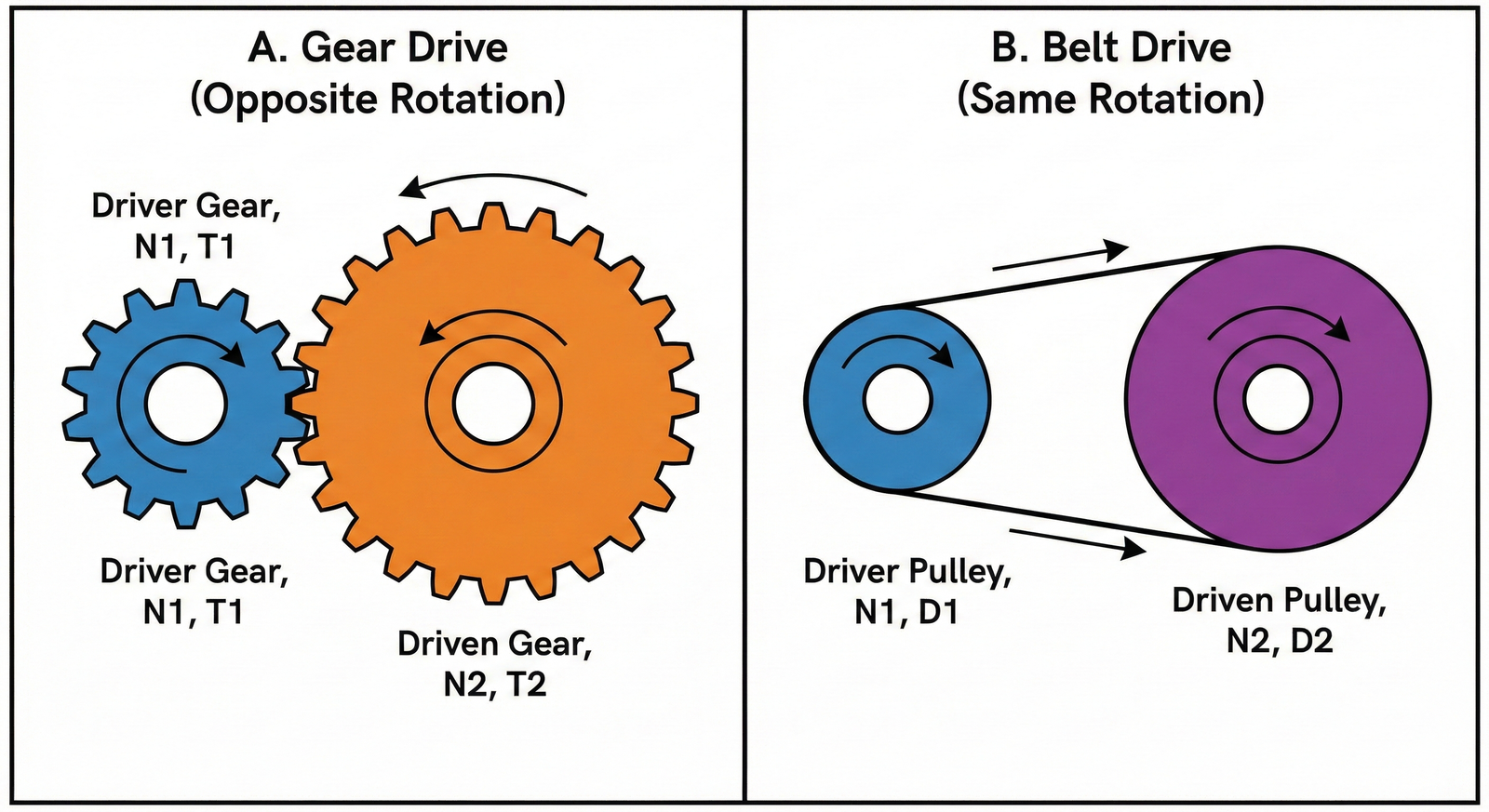
- To observe the directional changes of driven shafts relative to driver shafts in interlocking versus parallel pulley setups.
- To analyze the kinematic transition during the engagement of a friction clutch until synchronous speed is achieved.
- To study the conversion of kinetic energy into frictional heat during the application of a mechanical disc brake.
Required materials include:
- Virtual Kinematic Simulator: An HTML5-based engine rendering mechanical components.
- Interactive Configuration Panel: Controls for mechanism selection and Input Speed (RPM).
- Action Toggles: Dynamic engagement buttons for clutch and brake actuation.
- Live Telemetry HUD: Real-time digital readouts for Driver RPM and Driven RPM.
The procedure is divided into two parts:
Part A: Analysis of Continuous Drives (Gears & Belts)- System Setup: Select the Gear Drive module from the mechanism dropdown.
- Observation: Adjust the Input Speed (RPM) using the slider. Observe that the smaller driver gear rotates the larger driven gear in the opposite direction.
- Calculation: Record the Driver RPM (N1) and Driven RPM (N2) from the HUD. Calculate the gear ratio.
(Where T is the number of teeth)
- Comparison: Switch to the Belt Drive module. Observe that both pulleys rotate in the same direction. Note the difference in speed ratios compared to the gear system.
- Clutch Operation: Select the Friction Clutch module. Ensure the system is initially
.png)
Initializing secure sandbox environment & decrypting simulation...