
Free Preview
Beam Balance: Determination of Unknown Mass
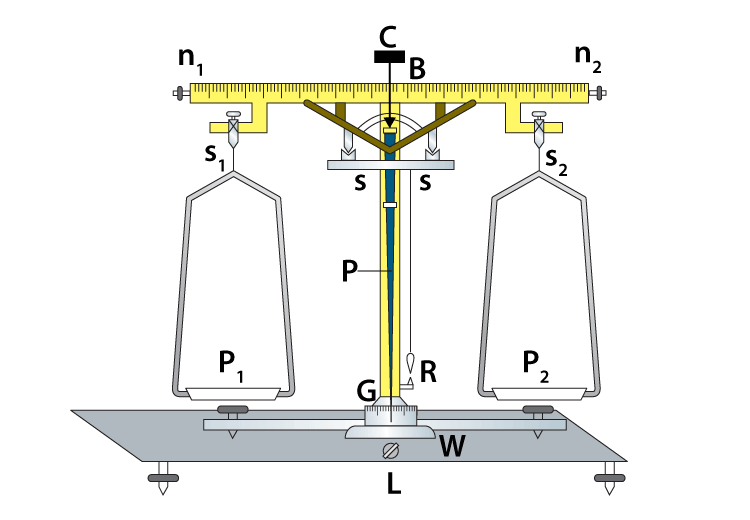
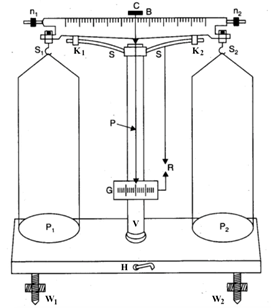
This experiment utilizes a physical beam balance (a lever system) to determine the mass of an unknown object by comparing it with known standard weights. It demonstrates the principle o...

This experiment utilizes a physical beam balance (a lever system) to determine the mass of an unknown object by comparing it with known standard weights. It demonstrates the principle of moments and static equilibrium. In this virtual environment, we simulate the gravitational force and torque acting on the pans to achieve a 'null point' where the beam is perfectly horizontal.
The objective of this experiment is to understand the principle of moments, represented mathematically as:
Furthermore, the goal is to determine the mass of an unknown object ($m_{1}$) using a set of standard weights ($m_{2}$) and to observe the effects of sensitivity and damping on a precision measurement system.
- Beam Balance: A central pillar with a horizontal beam and two suspended pans.
- Standard Weight Box: A collection of masses ranging from 0.1g to 100g.
- Unknown Objects: Samples of iron, brass, and glass.
- Forceps: For handling weights to prevent oil or dirt from affecting the mass.
- Zero Adjustment: Ensure the empty balance is leveled; the pointer should rest at the zero mark. If it does not, the zero offset must be calculated using the formula:$$ \theta_{offset} = \text{Initial Pointer Reading} $$
- Object Placement: Place the unknown object ($m_{x}$) on the left pan. The beam will deflect toward the left due to the clockwise moment.
- Counter-Balancing: Add standard weights to the right pan, starting from the heaviest possible mass down to the fractional weights.
- Achieving Equilibrium: Continue adjusting weights until the pointer oscillates equally on both sides of the zero mark or rests exactly at zero.
- Calculation: The unknown mass is the sum of the standard weights on the right pan, calculated as follows:$$ m_{unknown} = \sum_{i=1}^{n} w_{i} $$
- Verification: Use the 'Verify Mass' feature to check if the calculated mass matches the true physical mass within a tolerance of ± 0.05g.
Initializing secure sandbox environment & decrypting simulation...