
Free Preview
Determining the Frequency of Alternating Current (A.C.) Mains Using a Sonometer
The sonometer is an apparatus utilized to investigate the transverse vibrations of stretched strings. In this experiment, an alternating current is passed through a non-magnetic wire st...

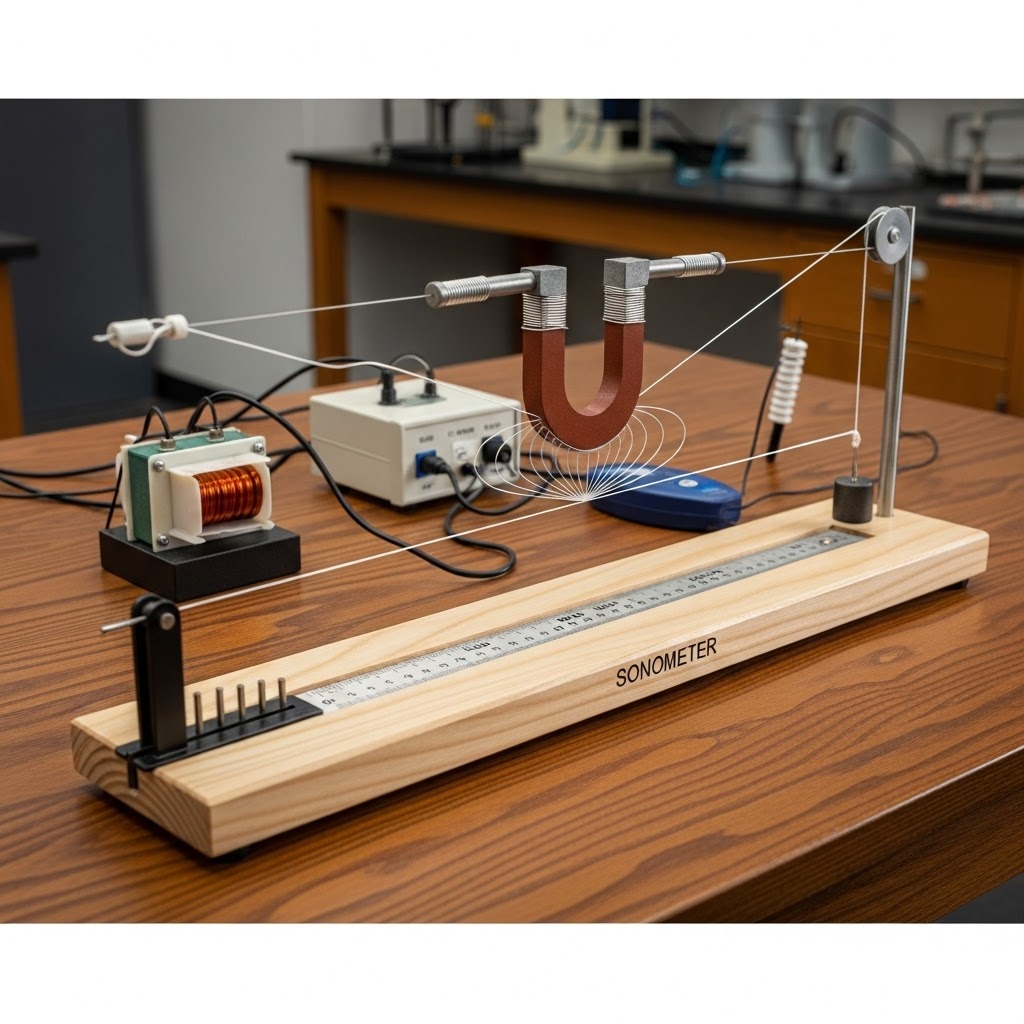
The sonometer is an apparatus utilized to investigate the transverse vibrations of stretched strings. In this experiment, an alternating current is passed through a non-magnetic wire stretched over a sonometer box. A strong magnetic field is applied perpendicular to the wire using a horseshoe magnet. The interaction between the oscillating current and the magnetic field induces vibrations in the wire. By adjusting the vibrating length, the natural frequency of the wire can be made equal to the frequency of the A.C. source, resulting in resonance.
- To study the resonance phenomenon in a stretched string.
- To determine the frequency of the A.C. mains supply (typically 50 Hz or 60 Hz depending on the region).
- To verify the relationship between the vibrating segment length and the applied tension.
- Sonometer: A hollow wooden box with a stretched wire.
- Step-down Transformer: Used to lower the 220V mains voltage to a safe 6V.
- Horseshoe Magnet: Provides a strong, uniform magnetic field.
- Sonometer Wire: Non-magnetic metallic wire (usually Copper or Brass).
- Weight Hanger and Slotted Weights: Used to apply tension ($T$) to the wire.
- Two Sharp-edged Wedges (Bridges): To define the vibrating length.
- Paper Rider: A small V-shaped piece of paper to detect resonance.
- Meter Scale: To measure the length.
- Setup:
- Place the sonometer on a table. Ensure the pulley is frictionless.
- Connect the step-down transformer (6V output) to both ends of the sonometer wire.
- Suspend a specific mass (e.g., $M = 500 ext{ g}$) from the free end of the wire using the hanger.
- Positioning:
- Place the horseshoe magnet at the center of the wire such that the magnetic field is horizontal and perpendicular to the wire's length.
- Position the two wooden bridges on either side of the magnet.
- Finding Resonance:
- Switch on the A.C. supply. The wire will begin to vibrate slightly.
- Place a small, light paper rider (V-shaped paper) on the wire between the two bridges.
- Slowly adjust the distance between the two bridges by moving them symmetrically inwards or outwards.
- Observe the paper rider carefully. At a specific length, the wire will vibrate with maximum amplitude (resonance), causing the paper rider to fly off.
- Measurement:
- Immediately switch off the current after the rider falls to stop the vibration.
- Measure the distance between the two bridges using the meter scale. Record this as the resonating length ($l$).
- Repetition:
- Change the tension by adding more weights to the hanger (e.g., increase by 50g or 100g).
- Repeat the process to find the new resonating length for the new tension.
- Take at least 4-5 sets of readings.
.jpeg)
Initializing secure sandbox environment & decrypting simulation...