
Free Preview
Overview The Distillation & Fractional Separation Bench provides an interactive simulation environment to investigate the physical separation of homogeneous, miscible liquid ...
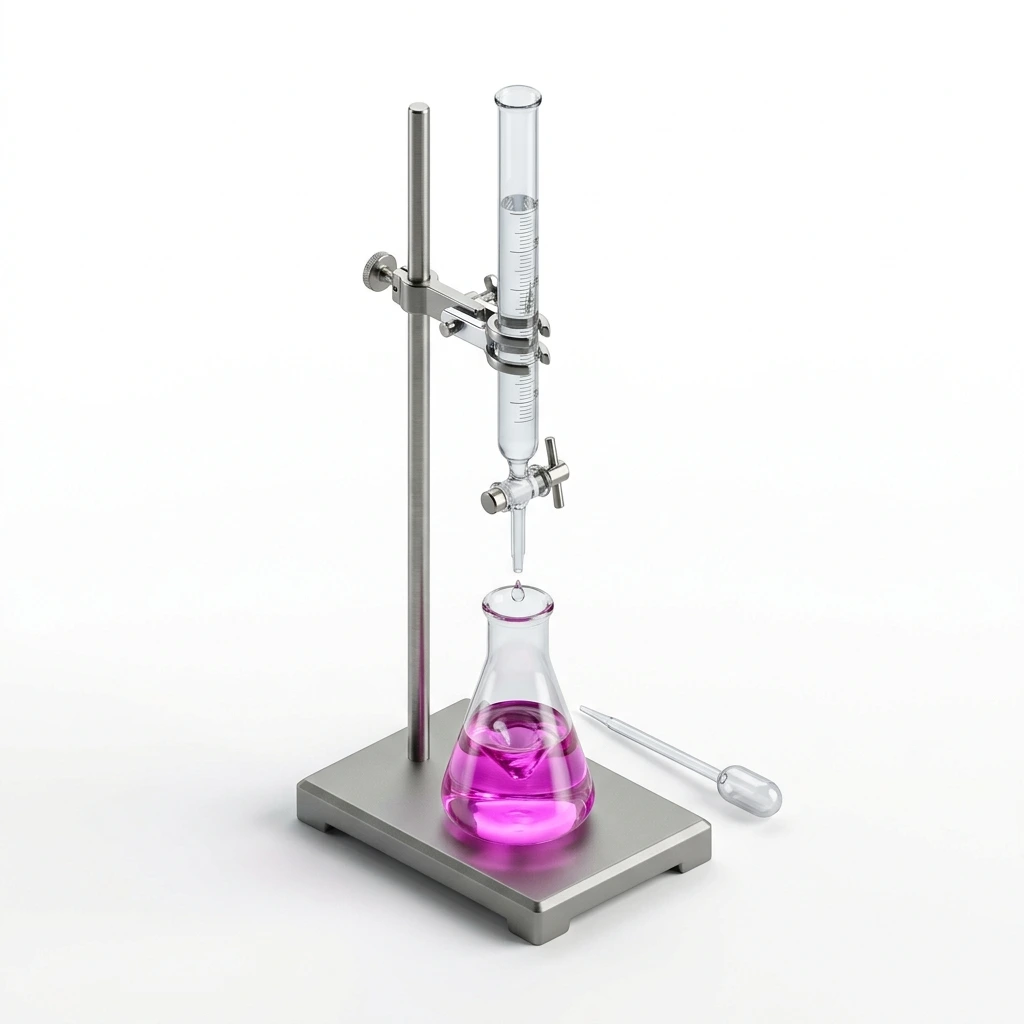
The Distillation & Fractional Separation Bench provides an interactive simulation environment to investigate the physical separation of homogeneous, miscible liquid mixtures and solutions based on their relative volatilities and vapor pressures. Driven by a variable-power Bunsen burner and cooled by a counter-current Liebig condenser, the simulator models thermodynamic phase equilibria, boiling point plateaus, and condensation kinetics in real time[cite: 2].
Students compare two fundamental configurations: Simple Distillation for separating miscible liquids with a boiling point difference greater than 25°C (e.g., Acetone at 56°C and Water at 100°C) or extracting a solvent from a non-volatile solute, and Fractional Distillation incorporating a Vigreux column with packed glass beads to provide repeated vaporization-condensation cycles (reflux) for separating mixtures with close boiling points (e.g., Ethanol at 78°C and Chloroform at 61°C)[cite: 2].
- Vapor-Liquid Separation Principles: To understand how differences in component volatility and vapor pressure enable thermal separation of homogeneous mixtures without chemical alteration[cite: 2].
- Apparatus Selection Criteria: To determine whether to use simple distillation or fractional distillation based on the 25°C boiling point differential rule[cite: 2].
- Fractionating Column & Reflux Mechanics: To evaluate how the increased surface area from glass beads inside a fractionating column enables repeated micro-condensation and re-evaporation cycles[cite: 2].
- Counter-Current Condenser Dynamics: To verify that cooling water must circulate into the lowest port and discharge from the highest port to keep the jacket fully primed and eliminate air bubbles[cite: 2].
- Thermographic Profile Analysis: To observe and record the characteristic temperature plateaus corresponding to the boiling points of distilling fractions[cite: 2].
-
Heating & Clamping Rig:
- Bunsen burner with adjustable gas jet and air collar[cite: 2]
- Cast-iron retort stand with bossheads and three-prong clamps[cite: 2]
- Tripod support ring with ceramic wire gauze[cite: 2]
- Adjustable scissor laboratory jack[cite: 2]
-
Specialized Distillation Glassware:
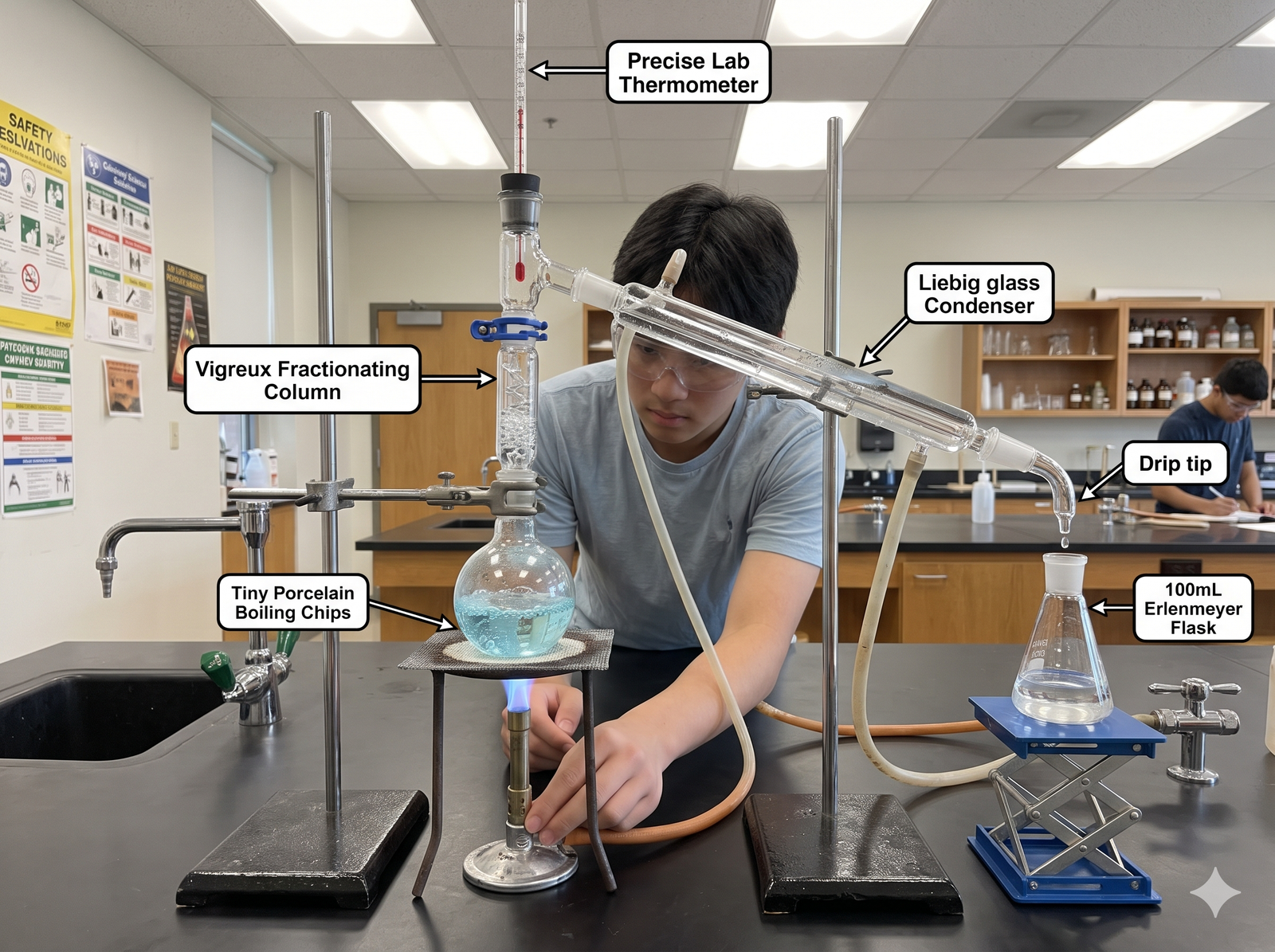
- 250 mL round-bottom borosilicate boiling flask[cite: 2]
- Vigreux fractionating column with packed borosilicate beads[cite: 2]
- Three-way still head take-off adapter[cite: 2]
- Liebig double-jacket water condenser[cite: 2]
- Vacuum / bent delivery adapter with drip tip[cite: 2]
- 100 mL Erlenmeyer conical receiving flask[cite: 2]
-
Instrumentation & Reagents:
- Precision laboratory thermometer (0°C to 120°C range)[cite: 2]
- Porcelain boiling chips (pumice anti-bumping stones)[cite: 2]
- Flexible silicone water circulation tubing[cite: 2]
- Test Mixture 1: Acetone (BP: 56°C) + Water (BP: 100°C)[cite: 2]
- Test Mixture 2: Chloroform (BP: 61°C) + Ethanol (BP: 78°C)[cite: 2]
- Test Mixture 3: Saltwater (Water + non-volatile solid NaCl)[cite: 2]
- Select the liquid mixture from the control panel (e.g., Acetone + Water)[cite: 2].
- Choose the apparatus mode: select Simple Distillation (ΔTb > 25°C)[cite: 2].
- Verify that porcelain boiling chips are loaded in the boiling flask to provide nucleation sites and prevent superheated bumping[cite: 2].
- Check the thermometer placement: the mercury bulb must sit level with the side-arm take-off to measure the true entering vapor temperature[cite: 2].
- Toggle the Condenser Water switch to ON[cite: 2].
- Verify that cold water enters the lower port and exits the upper port to the drain sink (counter-current cooling)[cite: 2].
- Adjust the Bunsen burner power slider to 70%–100% to initiate heating[cite: 2].
- Track the flask temperature as thermal convection heats the mixture toward the boiling point of the more volatile component[cite: 2].
- Observe the liquid boil; vapors ascend into the still head and pass into the Liebig condenser[cite: 2].
- As vapor condenses inside the inner tube, observe pure distillate dripping from the bent adapter into the receiving flask[cite: 2].
- Note that the thermometer reading stabilizes at the boiling point of the lower-boiling component (Acetone: 56°C) while it distills[cite: 2].
- Once the first component is depleted from the boiling flask, observe the temperature climb toward the second component's boiling point (Water: 100°C)[cite: 2].
- Select the Ethanol + Chloroform mixture (ΔTb = 17°C < 25°C)[cite: 2].
- Switch the apparatus to Fractional Distillation to mount the Vigreux column packed with glass beads between the boiling flask and still head[cite: 2].
- Re-ignite the burner and track the ascent of vapors through the column[cite: 2].
- Observation: Vapors undergo continuous micro-condensation and re-evaporation on the bead surfaces (reflux), allowing pure Chloroform (61°C) to distill over first, followed by Ethanol (78°C) once the column equilibrium shifts[cite: 2].
Initializing secure sandbox environment & decrypting simulation...